Showing posts with label gods. Show all posts

Tuesday, July 8, 2014

THE BURNING EYE OF TRUTH

Sir Ward art by +Sara Machajewski; note holy symbol on the shield 

GORGATHON IS PLEASED. His paladin Sir Ward, Knight of Jet and Gold, bearer of the torch of knowledge, has been returned to mortal form by the efforts of his comrades. EACH of these comrades has gained Gorgathon's blessing, and each may use the following ONCE*:

THE BURNING EYE OF TRUTH
Light a torch while saying Gorgathon's prayer. All within this torch's light is revealed: magik, invisibility, alignment, lies, traps, doors. The one who lit the torch can see all in it's light, no matter how far away from it.
These effects last until the torch goes out. The flame is not artificially sustained, and is subject to environmental conditions as normal flame.

SIR WARD and other PALADINS of Gorgathon may use this ability once per week, or once every 3 sessions.
CLERICS of Gorgathon may cast this as a Spell, choosing one of the things listed above to be revealed for each spell level  - if cast as a 6th level spell, all is revealed. If cast as a 3rd level spell, three things from the above list are revealed.

In both cases, a torch must still be lit, and the effects fade when the torch goes out.

*Note that the light of Gorgathon does not shine in every plane, and if the DM decides this doesn't work in their game, the player shall not pout or argue.

SIR WARD, you seek purpose.
-Gain and apply your knowledge to restore life where you have taken it in error

-Spread the word of the Eye of Fire to other planes; gain converts and new followers of Gorgathon; encourage them to adventure and seek knowledge as you do

-Make (or help make) a place such that adventurers may gather there, and spread their gathered knowledge to each other

-Should your companions seek that like which came from Manzarin and was expired, let them seek it in the Interstices

I do not hide knowledge behind awesome poems. May the light of knowledge shine upon you.

Friday, April 26, 2013

Holy Shit (or, native Clerics and Paladins on Kalak-Nur)

Clerics in Kalak-Nur are as the Labyrinth Lord Class except:
-Weapon and armor restricted by deity (not restricted to Blunt weapons)
-Turn Undead is a spell and it's effects vary by deity
-WIS bonus (if any) = # of bonus spells at 1st level

Paladins as LL except:
-Alignment restrictions are by deity (not only lawful deities have Paladins)
-Turn Undead once per day per level
-"Lay on Hands" may be reversed and/or used on objects (2 HP healing or damage to a person or object 1/day by touch);
-Cure Disease OR "Lay on Hands" 1/day, not both;
-Detect Evil actually detects intension or lies (good and evil are not absolutes to natives)
-Protection from Evil, 10' radius may have unpredictable effects
-The steed summoned at 4th level will not be a horse unless a portal to another plane is open

Kalak-Nur uses the following alignments for natives:
Outsiders, however, tend to keep their notions of Good and Evil and the related powers.

Some Gods, and their followers' abilities:

Gorgathon, The Eye of Fire - god of knowledge, light, the sun and moon. The Sun is his right eye, ever watching, all seeing, ever gathering knowledge of all things.
The moon is his left eye socket, his left eye lost in a godwar (actually stolen by The-Knife-In-Darkness and hidden in a monster's belly). The left eye socket represents "turning a blind eye", seeing and letting go, forgiveness, knowing but not acting upon.
Often worshipped by magic users, his followers are voracious gatherers of knowledge.
His Clerics have access to Divination spells from the Magic-User list, and Magic User worshipers vice versa. His worshippers may not learn spells of Darkness or Cold.
Symbol: The sun and moon.
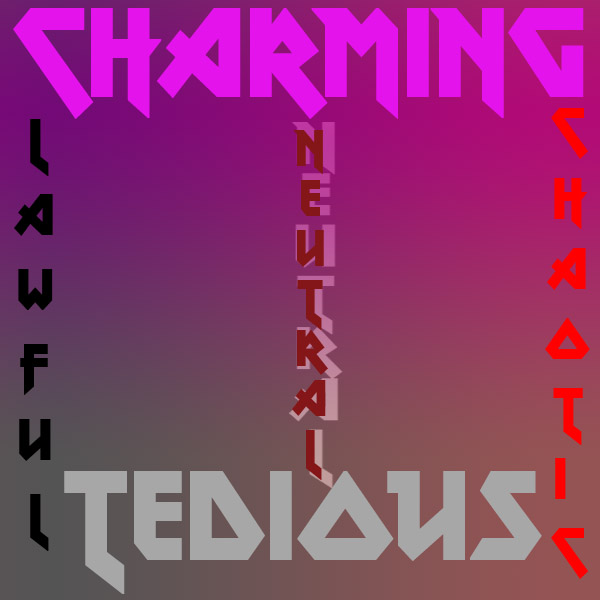
AL: Neutral Charming (although his opponents find him Tedious, and his followers tend toward Law)
Cleric Weapons: be judicious in the use of fire, do not destroy sources of knowledge; it is encouraged but not required to discover and disseminate strange weapons and methods of fighting
Turn Undead: will also repel creatures of Darkness/Shadow and the ignorant (those who fear knowledge); only works in light shed by open flame, sun or moon.
Paladins: May take 1 round to  MARK any creature or item they can see; by concentrating and taking no other actions for 1 TURN, they will know where the light of the sun or moon last shone upon that person or item (none may escape the burning eyes of Gorgathon.)
By concentrating for 1 TURN in the open sun or moonlight, a Paladin of Gorgathon may use "Lay on Hands" or Cure Disease an extra time per day.

NICE BOOTS LET'S MAKE LOVE - a Tyrannosaurus Hex that very recently absorbed so much magical energy she became the God of War, Chaos, and Confusion.
AL: CHAOTIC. Charm or Tedium have yet to be established.
Wild Mages may become her Clerics at any time, but cannot undo this decision.
Cleric Weapons: Use your natural weapons, or spells. Seek mutations to give you natural attacks. 
IF you have no natural claws/teeth/etc, you may use a Polearm or dagger. The amount of HD of creatures you've killed with your Polearm is your percentage chance to gain a Claw, Bite or Breath weapon. You may only attempt this spontaneous mutation once. If successful, 1d6: 
1)Claw1d4 
2)Claw1d6 
4)T-Rex Legs, Kick 1d8 
5)Big Teeth Bite 1d6, also bleeds another 1HP that # of rounds after
6)Breath Weapon determined by DM
Turn Undead: Is a spell. Can be used to Control Undead or Turn Lawful Creatures as well.
Spells: As a Wild Mage with access to Cleric Spells. No healing. Anything that refers to Evil and any radiuses centered on you create Wild Magic Zones. Here are some Wild Magic Tables.
Paladins: 1 in 6 chance of a Wild Surge any time a Paladin ability is used. Protection from Evil, 10ft Radius is not that at all - it's a Wild Magic Zone, 10 ft around you for every two levels you have gained, 3 rounds a day +3 rounds per level gained. That's right, Wild Magic for everyone. You are truly a holy warrior, delivering the gift of your Goddess to all you encounter. Every time you gain a level, there is a percentage chance equal to that level that you turn into a Tyrannosaurus Hex and go crazy for that many days. So at level 3, There's a 3% chance you become a T-Hex and rage out for 3 days. At the end of your rage, you are still a big dinosaur covered in sloppy runes, but you have your old mind back. This will probably affect the stats on your sheet only minimally, but will affect reactions to you quite a bit.

Vanamanaghor-Knife-In Darkness - God(dess?) of darkness, stealth, deception. Not openly worshiped. Culturally a "lovable rogue" in that people like to tell hyperviolent stores of his/her exploits stealing from and assassinating the avatars of other gods, which s/he does purely for sport. To many, s/he is a symbol of getting one over on "superiors". The god does not reveal itself, so gender is unknown. Symbol: A black knife or a silver knife on a black field.
Clergy are all Cleric/Assassins. Can choose to create Darkness, 15" radius once per day per level instead of Turning Undead. As the spell.
As with all campaign things, this is a work in progress.

Monday, April 8, 2013

GODS OF KALAK-NUR

+Pearce Shea asked what gods were popular in Targenmoor, so I figured I'd post the Gods of Kalak-Nur as localized to there.


Famat-the-Veiled - Goddess of haggling, markets, trade, negotiation. Symbol: a smile behind a veil. Priests often calm the fights of others, but have heated arguments among themselves - then they go drinking as friends or lovers after.


Vanamanaghor-Knife-In Darkness - God(dess?) of darkness, stealth, deception. Not openly worshiped. Culturally a "lovable rogue" in that people like to tell hyperviolent stores of his/her exploits stealing from and assassinating the avatars of other gods, which s/he does purely for sport. To many, s/he is a symbol of getting one over on "superiors". The god does not reveal itself, so gender is unknown. Symbol: A black knife or a silver knife on a black field.


Monot-Grim-Faced - God of duty and The Grey Waste. Find your stitch in the fabric, find your place and get in it. Do not excel, do not slack, perform your duty and hold your tongue. Be even as the grey sand that blankets and surrounds us. This church receives regular and substantial donations of money, land, legal help, and other resources from anonymous sources. Symbol: below.


Chchcchchctktktktktk - An insect god worshipped by the humanoid bug people. Presented to humans as a humorous goof. Many things about this god are unknown outside bugperson communities, and those bug people that co-habitate with humans do not worship it.


Gorgathon, The Eye of Fire - god of knowledge, light, the sun and moon. The Sun is his right eye, ever watching, all seeing, ever gathering knowledge of all things. 
The moon is his left eye socket, his left eye lost in a godwar (actually stolen by Vanamanaghor-Knife-In Darkness and hidden in a monster's belly). The left eye socket represents "turning a blind eye", seeing and letting go, forgiveness, knowing but not acting upon.
Often worshipped by magic users, his followers are voracious gatherers of knowledge. His Clerics have access to Divination spells from the Magic-User list, and Magic User worshipers vice versa. His worshippers may not learn spells of Darkness or Cold. Symbol: The sun and moon.

(Kay Nielsen)


Slumugsh, God of trash, decay, age, time, fungus, slimes, oozes, jellies, unintelligent bugs, and the lost - its worshippers cultivate carelessness, do not become attached, lose things without a concern, feed those that feed on decay, and do not clean, leaving that to natural forces and slime unguents they collect from the secretions of detritovores.


Havet - dual aspect God and Goddess of Ice, Trolls, Frost Giants, hardness, toughness, challenge - worshipped by those who build everything they use, bind their own wounds, throw themselves into conflict and challenge, and do not cultivate soft round asses on opulent cushions. They scoff at the well to do, nobles and merchants alike, and scorn the hoarding of comfort.
Havet was once the God of the Sea and had a different aspect, but none in this region remember what the word "Sea" means.


Digrot - god of death, the undead, and dust.


(later edit: took out Vanamanaghor-Knife-In Darkness's nickname, as it was causing confusion in my home group with Gorgathon.)

Thursday, March 21, 2013

“All God does is watch us and kill us when we get boring. We must never, ever be boring.”

(Quote from Invisible Monsters by Chuck Palahniuk)

Some gods I made up for characters or my own settings.

DERKETA
Derketa is a goddess of death, secrets, and the harvest.
Some say she has no servants other than her clerics, but some say all serve her, and only those who realize it can die happy.
When you die, she takes you in her embrace and you and she whisper secrets back and forth, eternally.

Undead are those who have cheated the Goddess; lovers who have spurned her and must be sent back to her forgiving arms.

The living should not turn away from danger - Derketa does not make mistakes. If it is not your time and you have her favor, you will come through danger victorious. If she feels you have lessons still to learn, secrets still to gather for her, you will survive, chagrined. Certain death should only be met when one feels one has gathered all there is to offer from life, but situations where there is some slim chance of survival are not shunned.
Some claim to have glimpsed her when near death; she appears as a purple-robed figure in a bright field of crops. When she turns to you, her face is skull-like, but it is not fearsome; you have been waiting for her all your life. Her embrace is neither warm nor cold, but her breath is pleasant, like the smell of a warm fire on cold winter air.
Clerics: Her followers see no conflict with healing. Her Clerics consider themselves her direct agents, and it is for them to decide if it is someone's time. They take responsibility for being death or keeping someone from it. Her followers are encouraged to live life heartily and experience all it has to offer, to collect experiences, luscious sensations, secrets and obscure knowledge so that one might have many interesting things to whisper back to her in "the long embrace".
They enjoy bawdy songs and befriending unlikely creatures.
Alignment: Any non-Lawful. Her clerics operate under an intuitive interpretation of her whims, not a rigid system of rules. They tend to not be evil, as they try to function within a community, not take advantage of it.
Symbol: A skull with two sheaves of wheat crossed under it and stylized breath coming out of it's mouth.

NICHT
Nicht is the void between life and life, the void between the worlds.
The void takes a god with no more worshippers, the void takes a man when his body fails.
When you have better enemies than friends, when your guardsman takes coin to turn down the wrong hallway, when the curtain stirs, when the knife slides in through your back and you cannot breathe, Nicht is there, and you become part of Nicht.
The void has intelligence; The Nothing has plans - and followers. This dread intelligence is alien to man, however; to stay on its path yet remain usefully sane, Nicht's followers engage in a regimented form of daily meditation.
Their ways are secret. They consider uniting a target with Nicht to be delivering a blessing, a gift. Gifts cost money, however; Nicht's followers are both merchant and messenger.
Clerics: all are multiclass Cleric/Assassins, and must meet the ability score requirements for such in the 1E AD&D PHB. They may be of any race, but those who are not Orcs, Half Orcs, or Beast Men often hide their worship when in society. To advance in level as a Cleric they must heal someone from the brink of death. To advance as an assassin, they must successfully use the Assassinate ability once or fail at it three times.
Alignment: Nicht is Chaotic Neutral, its followers can be any Neutral. Nicht is not balance; balance is something.
Symbol: a blank grey square with sharp edges.

BASABAT
A god of sensual pleasures and rest from effort, this deity is worshipped by hedonists and the lazy. The two types of worshippers can become frustrated with one another, but their divisions are short lived. Basabat is known to manifest often, and choose sex of its avatar based upon whom it plans to seduce at any particular moment. Its most distinctive appearance is that of a humanoid with catlike features, the degree of which can vary.
Clerics: Seek pleasures for their own sake. Amass a fortune, then blow it on a weekend of excess with your companions. Seek the path of least effort, but do not shy from effort when the reward is a greater span of pleasure. Mercilessly annihilate those who disrupt or seek to destroy your pleasure.
Cats favor these Clerics and may help them in small ways. The Cleric can forgo having a first level spell to incur the favor of cats in a direct way three times a day. (trip enemies, see through eyes for 1 rd/lvl, provide a distraction, loose a rope, knock over a kettle, etc) IE Use a spell slot for this 3/day instead of a spell.
Alignment: Basabat is True Neutral, but unpredictably Good or Evil in that it will sometimes strive for the pleasure of others and sometimes mercilessly pursue its own pleasure. Clerics may be any neutral. Effort must be balanced with pleasure.
Symbol: a peacock feather, or the feather of a bird hanging from a cat's mouth.

Monday, February 4, 2013

God Money Don't Want Everything He Wants It All


Gods are governments, gods are money, gods are "Too weird to live, too rare to die."

If you don't give a shit about the context and just want to skip to the juice, go to the *.

When I was originally playing D&D, I just let gods sorta be the abstract mythological spell-granters and deus ex machina that 2E made them out to be. 2E had some interesting ideas about gods, though, like they completed for influence of different spheres (oh shit the God of Magic died everyone jockey to take his/her place!) I can't remember if it was 2E or reading Neil Gaiman later that introduced me to the idea that gods have power relative to their amount of followers and the degree of faith those followers have.

When I got back into the hobby with 4E, then back back with the OSR early last year, I avoided the subject as much as possible. I didn't see a reason to figure out how gods worked. Eventually, though, I realized I was leaving out something that can add a lot of character to a campaign. What gods are and how they work is part of the "physics" of the campaign; players understanding that stuff helps them set goals and be creative with problem solving. After understanding that, I knew I'd have to deal with it eventually, but not how.

As there were more and more Kalak-Nur sessions on G+ and my home game players joked that the next person to die has to play a Cleric, I knew it was time to figure it out. I've been listening to several free courses on iTunes U, specifically "The Early Middle Ages" from Yale and "The International System in the 20th Century" from Stanford. Hearing about the relations of the different parts of the Roman Empire and the relations of world powers around 1900, and thinking about the tail end of the Cold War era of my youth, something clicked and I got it.

*Gods are like world powers during a Cold War; they are competing for resources and ideological victories, but most of the time the risks of open war on each other is too great. They are too interdependent for that. Competition leads to disagreements, however. Treaties are drawn up. Pacts are made. Backdoor treaties are signed, some contradicting those more overt. Because the big powers can't make open war on each other, sometimes in all the twisty wordings of agreements, smaller powers get a leg up.

Priests are like spies and diplomats, helping allies but also keeping tabs on them. Of course, they are always looking for ways to hurt their enemies. This happens either through direct attack on priests of enemy gods or longer term manipulation of economies, society, and ideologies to diminish belief, and thus their godly power. All gods and their devout followers are playing a long term game, to increase the number of followers, intensity of belief, and even perception of the faith by non-believers.

So what are gods in this line of thinking? I like that every DM has their own ideas about what the gods are, but here's what they are to me.
Gods have several possible origins:
1. Two other gods breed, and then must find or cultivate an idea or sphere of influence for their offspring to take over and cultivate a following for them.
2. Somehow belief in a god that does not yet exist spreads to the point that they come into being.
3. A mortal is chosen by the gods in a pantheon to be uplifted and take over a sphere of influence or idea that is currently "orphaned".
4. A mortal becomes so uniquely powerful, revered, and strange that mortality is no longer appropriate.

Obviously the last two have potentially greater ramifications for PCs. The first two can generate a lot of great story hooks, however, and that's what this is really all about. Gods are there in the game, so I want them to generate adventure and give the PCs interesting choices.

I figure at some point, a creature becomes so powerful that the god option opens to them; gain functional immortality and be able to grant abilities to others and all that, at the trade off of your power being limited by the strength of the faith in you. This could lead to other interesting ramifications, like gods who are still around even though the faith in them has all but vanished. They'd still be somewhat immortal and have all these weird powers, but with limitations that put them in odd situations...situations maybe PCs can help them with or help others out of.

Anyway, GODS. Waddaya think? Here's a weird picture of Jesus fishing for a sea monster with the apostles and himself as bait. I think bait-Jesus has a bow in his hurr.

Thursday, October 11, 2012

Shen-Drath, "Ol' Two Face", God of War (for old school D&Dish games)

A player in my home game asked about gods, and joked about the next player being forced to play a cleric. I don't think about religion a lot, and for some reason gods are real boring to me; I'm trying to make them interesting, though! I've got at least 2 others to write up. They probably won't be this lengthy or complicated.


Image by Bill Sienkiewicz from here

Shen-Drath, or "Ol' Two Face", is the God of War. Shen, his first aspect, represents training, strategy, order, and duty. Drath, the other aspect, represents chaos, bloodlust, berserker rages, disorientation, and the collapse of order. Together, they are the duality of war.
Shen-Drath's holy symbol is half human face, half bloody skull. The entire symbol is used, even by factions that worship one half over the other. Divisions within the church have emerged over arguments about how many arms the god has - those who favor Shen claim two, those who favor Drath claim many, many more - that he slices off the arms of foes in battle and attaches them as his own.
There is also disagreement as to whether Shen-Drath is a specific being that ascended to godhood through mighty deeds of war in ancient times, or whether the name is a kind of title. Believers of the latter say the mightiest warrior in the land can rise to become the god through a great ritual during which he survives burning away all the flesh on half of his body. A mortal is compelled to undertake this ritual when he or she reaches a level of martial prowess the other gods feel inappropriate for a mortal. Whether born of old or made anew, all agree he is the best military strategist and most bloodthirsty berserker in the land.
Casually worshipped by: Generals, politicians during war, some soldiers and berserkers
Seriously worshipped by: Soldiers, mercenaries, war priests, tacticians, some berserkers and generals

PC INFO:
Worshippers favoring Shen must follow orders, know their rank, carry out agreements and treaties, and treat prisoners of war well. Surender and retreat are acceptable if they are the optimal strategy for the situation.
Clerics favoring Shen have the normal armor and weapon choices of the Cleric class.
Worshippers favoring Drath must never retreat, take prisoners during combat, surrender, or spare a foe.

 Clerics favoring Drath or the deity as a whole may use any weapon, but may not wear armor greater than Chain Mail.


Paladins who worship Shen-Drath can not cure diseases or radiate Protection From Evil as other Paladins do.
Clerics may choose to Turn or Command Undead at the time of Turning.

Abilities:
-A History of Violence: The player of a Cleric or Paladin of Shen-Drath may keep a list of all the foes his or her PC has faced in battle; when facing a foe of the same type or from the same area again, the PC intuits some useful knowledge about their strategy, level of sophistication, or something else useful about fighting them. ("The orc tribes of Morath always attack in groups of 3." "Goblins in this area use stone weapons, which easily break." "Pirates from the isles of Neverbottom always ram ships from starboard." [Can you tell I'm not a military type? I hope you get the idea anyway. It should be potentially relevant or useful, but not give the fight away.])
-The Many Arms of War*: At levels 3, 6, 9, and 12, Clerics of Shen-Drath may forgo one of their spells to gain the following ability: during battle, if the Cleric can sever the arm of an animate foe, he or she may attach that arm and command it as if it were one of his/her own. This arm may make weapon attacks, aid in defense, hold items, or anything an arm can do. The foe must be alive or animate at the time the arm is severed; if severing the arm kills the foe, the arm will still work. At the end of the battle, the arm falls off and decays. (IE one arm at level 3, two at 6, etc.)
Paladins who worship Shen-Drath gain The Many Arms of War at 3rd level and may use as many arms as half their level, rounded down.
-Drath's Fury: By covering their face with the removed face, skull, blood, or viscera of a fallen foe, a Paladin or Cleric of Shen-Drath may enter a battle frenzy. During this frenzy, they gain temporary HP and bonus to hit and damage equal to half their level, rounded up. Their AC takes a penalty of 2 in this state and does not benefit from Dexterity bonuses. They must choose one enemy and attack that enemy until it is down, then will move on to the closest creature to attack next. If this is an ally, the Paladin or Cleric may make a saving thrown VS Spell aided by any Wisdom bonus to skip over them for the next nearest creature. If the saving throw fails, the frenzy has overtaken their senses and the ally is attacked until unconscious or dead.
A Paladin may not Lay On Hands the same day they have entered Drath's Fury. A Cleric must give up one spell that day to use this ability (which is gained back as normal at rest).

DM INFO:
Shen-Drath's manifestation is 30' tall and appears as one half man, the other half bloody and skeletal - made up of the bodies of mighty warriors and high priests of the past. One arm of any creatures falling in a battle with Shen-Drath will fly to him and defend him, or attack his foes, falling to dust after the battle is over. Shen-Drath carries a mighty battle-axe that he throws unerringly and has hideous laughter. His laughter can Paralyze whether he wants it to or not, but he will not attack helpless foes.
Shen-Drath is part of the Celestial Order, Gods who enforce universal constants, organize to determine rules of reality and enforce restrictions on their priesthoods and those of others. He wants to be the God of Death, and thus both hates and lusts for Derketa. He occasionally schemes to have her deposed or destroyed, but has not been successful. Shen-Drath is respected and considered useful by other Gods; Derketa is feared and beloved.
AC: -4 or 24, HP 400, No of Attacks: 1d4+number of creatures killed so far in combat, First attack 10-100 DMG, second and others 10-40+16; Abilities of a 15th level Cleric and 20th Level Paladin; Laughter causes Paralysis on a failed save.